Why Custom Deck Quotes Vary So Much
By Jake Jensen
Table of Contents
- Why Custom Deck Quotes Vary So Much
- Material Selection and Its Impact on Pricing
- How to Compare Deck Contractor Bids
- Site Preparation, Permits, and Hidden Costs
- Custom Deck Design Considerations That Affect the Quote
- Labor Rates and Contractor Overhead Transparency
- Composite Deck Installation Best Practices and Long-Term Value
- Conclusion
- Frequently Asked Questions
Last Updated: September 30, 2026
Why Custom Deck Quotes Vary So Much
When you call three contractors for custom deck quotes, you might get prices that differ by thousands of dollars. The variation reflects real differences in how contractors approach the project, what they include in their estimate, and what risks they're accounting for.
Understanding why custom deck quotes vary helps you make smarter comparisons instead of chasing the lowest number. The biggest variables are material selection, site conditions, labor costs, and how thoroughly a contractor has assessed your specific property. A vague estimate might look cheaper upfront, but it often masks hidden costs that surface mid-project.
Material Selection and Its Impact on Pricing
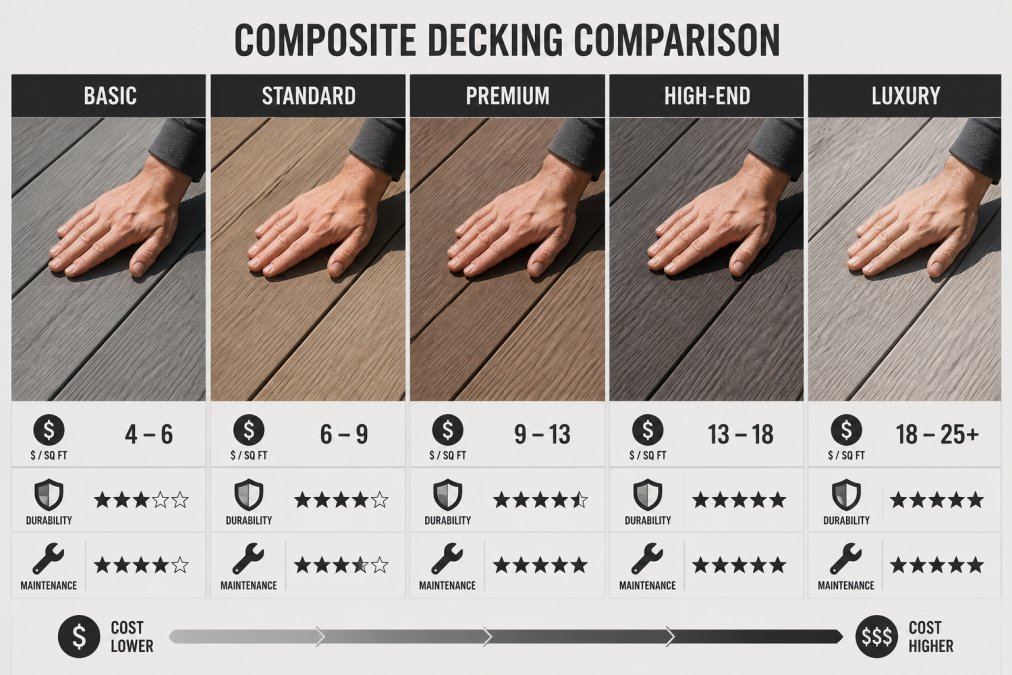
The material you choose is one of the largest cost variables in any custom deck project. Composite materials like Trex carry a different price point than pressure-treated lumber, and the grade and finish level of composite affects the quote significantly.
Composite decking eliminates much of the maintenance burden associated with other materials. It resists rot, splinters, and fading, which means lower long-term costs even if the initial material price is higher. Within composite itself, there are tiers. Mid-range composite costs less than premium brands but may show color variation or require more frequent cleaning. Higher-end composites hold color better and resist staining, which justifies the premium in the quote.
Your contractor's familiarity with specific materials also affects pricing. If they regularly install Trex composite and have supplier relationships, they might quote it more competitively than a contractor who sources it less frequently. The finish details matter too. Deck boards are one thing; railings, fascia, and trim add complexity and ripple through structural requirements and labor hours.
How to Compare Deck Contractor Bids
When you receive multiple custom deck quotes, comparing them directly can be misleading if each contractor has quoted different scopes. One bid might include site cleanup and debris removal; another might not. One might include permit fees; another might list them separately.
Start by ensuring all quotes cover the same scope. Ask each contractor to specify:
- Material type and grade for all components
- Square footage of the deck and any attached structures
- Whether site preparation, excavation, and soil removal are included
- Permit fees, HOA approval handling, and inspection costs
- Debris removal and daily site cleanup responsibilities
- Railing type, spindle spacing, and post specifications
- Timeline, start date, and expected completion date
- Warranty coverage, duration, and what voids it
- Change order process and how additional work is priced
Once you have apples-to-apples quotes, look at the cost-per-square-foot figure, but don't treat it as gospel. A contractor quoting lower might be cutting corners on framing quality or using lower-grade fasteners. The real insight comes from asking each contractor why their quote differs from the others. A contractor who explains their approach, "We're engineering this for a 60-pound snow load because of your elevation, which requires deeper footings and stronger framing", is showing their thinking and risk assessment.
The Quote-to-Contract Transition: Where Scope Creep Begins
A quote is an estimate; a contract is a binding agreement. Many contractors provide a quote without specifying exactly what it includes. During construction, when unexpected conditions arise or you decide on changes, those become "change orders" billed separately. By project completion, you've paid significantly more than the initial quote.
To prevent this, insist on a fixed-price contract, not a time-and-materials estimate. A fixed-price contract states: "The total cost for the scope described below is $X, and any changes to scope will be documented in writing and priced separately before work begins."
Before signing, the contract must include:
- Detailed scope of work: Not "build a deck," but specific dimensions, materials, and components.
- Material specifications: Brand, grade, and color for every component. "Composite decking" is vague; "Trex Enhance in Clam Shell" is specific.
- Site conditions assumptions: "Quote assumes level ground with no tree removal required" or "Quote includes removal of existing concrete pad."
- Change order process: "Any changes to scope must be approved in writing by homeowner before work begins."
- Payment schedule: Typically 50% deposit, 50% upon completion. Never pay 100% upfront.
- Timeline and penalties: "Project will begin on [date] and be substantially complete by [date]."
A contractor who resists putting these details in writing is signaling that they plan to be flexible with scope, which means flexible with price. That flexibility almost always goes upward.
Site Preparation, Permits, and Hidden Costs
Site conditions are often where custom deck quotes diverge most. Two properties that look similar can have very different subsurface challenges that dramatically affect the estimate.
Footing depth is determined by frost line depth in your region. In areas with deep freeze-thaw cycles, footings must go deeper to prevent heaving. A contractor who accounts for local building codes will quote deeper footings than one who doesn't.
Soil type matters too. Rocky soil requires different excavation approaches than clay or sandy soil. If your property has poor drainage, the contractor might need to add gravel or implement drainage solutions. These aren't always obvious from a site walk, which is why some contractors quote conservatively and others miss them entirely.
Permit fees vary by jurisdiction.
Custom Deck Design Considerations That Affect the Quote
The design complexity of your deck directly impacts labor hours and material costs. A simple rectangular deck is straightforward to quote. A multi-level deck with built-in seating, stairs at multiple angles, or integrated pergolas requires more planning and execution.
Custom design considerations include:
- Deck shape and angles: Straight edges are faster to build than angled or curved designs.
- Elevation and stairs: Multi-level decks require additional structural engineering and more labor.
- Built-in features: Benches, planters, or storage underneath add complexity and custom framing.
- Railing design: Standard railings are faster than custom designs with specific spacing or materials.
- Integration with existing structures: A deck that ties into a house or pergola requires careful flashing and connection details.
Labor Rates and Contractor Overhead Transparency
Labor rates are where contractor quotes diverge most significantly, and the variation often reflects structural differences in how contractors are licensed, insured, and bonded.
- Hourly labor rate or total labor hours (not both hidden in a lump sum)
- Insurance and bonding costs (either itemized or explained as part of overhead)
- Warranty coverage details (what's covered, for how long, and what voids it)
- Crew size and timeline (so you understand how long the project will occupy your property)
Composite Deck Installation Best Practices and Long-Term Value
Composite decking requires specific installation techniques, and how a contractor approaches this affects both the initial quote and the deck's longevity.
Proper composite installation includes:
- Adequate ventilation: Composite needs airflow underneath to prevent moisture buildup and mold.
- Proper fastening: Composite requires stainless steel or composite fasteners, not standard galvanized nails.
- Thermal expansion: Composite expands and contracts more than traditional materials. Proper spacing and fastening accounts for this movement.
- Flashing and water management: Proper flashing where the deck meets the house prevents water damage.
Conclusion
Custom deck quotes vary so much because they reflect real differences in material choices, site conditions, design complexity, and contractor experience. A low quote often means missing scope, underestimated site conditions, or lower-quality materials. A high quote might reflect thorough site assessment, premium materials, and experienced installation.
Frequently Asked Questions
What structural factors cause the biggest swings in custom deck quotes?
Footing depth, load-bearing requirements, and local snow load specifications drive major price differences. In regions with heavy winter snow, engineers must design for significantly higher structural loads, requiring deeper footings, stronger framing materials, and more robust support systems. A deck engineered for standard conditions costs far less than one built to handle 40+ pounds per square foot of snow load. Site soil conditions also matter, poor drainage or unstable ground requires additional excavation and reinforcement, raising labor and material costs substantially.
How do I know if a contractor's bid includes all the necessary permits and HOA paperwork?
Ask directly whether the quote covers permit fees and HOA submission costs, or if those are separate. Some contractors include permit coordination in their fixed price; others charge it as an add-on. Request a detailed line-item breakdown showing permit costs, application fees, and inspection charges. Also confirm whether the contractor will handle HOA documentation and revisions or if that falls to you. A transparent contractor will spell this out upfront and provide a clear timeline for approval before work begins.
Why does composite deck installation cost more than other material options?
Composite materials cost more upfront but deliver decades of durability with minimal maintenance. Composite decking resists rot, insects, and weather damage. Installation complexity also differs, composite requires precise fastening techniques and proper ventilation to prevent moisture issues. The long-term value justifies the higher initial investment because you avoid costly repairs and replacements over 20+ years. Contractors familiar with composite installation best practices will price the job to reflect the skill and precision required.
How can I avoid surprise costs and scope creep during my deck project?
Request a fixed-price contract that defines the exact project scope, materials, and timeline before work begins. The contract should list what is included and explicitly state what triggers change orders. Ask the contractor to walk the site with you, document existing conditions, and identify potential obstacles (underground utilities, poor drainage, accessibility challenges) before quoting. A detailed written estimate protects both parties. Also establish a clear process for approving any changes in writing before work proceeds, this prevents misunderstandings and ensures costs stay predictable.
At Next Level Exteriors, we quote every project personally within 48 hours, with no commissioned salesmen or pressure tactics. We handle permits, HOA approvals, and site cleanup as part of the process, and we engineer every deck to withstand Utah's snow loads and freeze-thaw cycles. If you're ready to understand exactly what goes into your custom deck quote, reach out for a transparent, pressure-free estimate.
Plan your project with Jake
Share your project type, location, scope and timing. Jake confirms an on-site estimate after your callback.