JV Custom Decks Alternative: Find Your Best Contractor
By Jake Jensen
Table of Contents
- Why Homeowners Search for JV Custom Decks Alternatives
- Deck Builder Comparison Checklist: What to Evaluate
- Key Deck Contractor Questions to Ask Before Hiring
- Deck Permit Requirements and Engineering Considerations
- Deck Snow Load Engineering for Utah's Climate
- What Sets a Premium Deck Contractor Apart
- Making Your Final Decision
- Frequently Asked Questions
Last Updated: October 17, 2026
Why Homeowners Search for JV Custom Decks Alternatives
Searching for a jv custom decks alternative means you're asking the right question: what other options exist, and how do you know which contractor will actually deliver?
The truth is, homeowners in the Wasatch Front face a specific challenge.
At Next Level Exteriors, we've worked with homeowners who compared multiple contractors first. They weren't looking for the cheapest option, they wanted someone who would show up, do the work right, and stay accessible.
This guide covers what to evaluate when comparing deck contractors: the questions to ask, the red flags to watch for, and the criteria that matter for a deck built to last decades in this climate.
Deck Builder Comparison Checklist: What to Evaluate
Finding the right contractor starts with knowing what to measure. Most homeowners focus on price alone, but a contractor who quotes low and cuts corners on engineering or materials will cost far more in repairs down the line.
Top-ranking pages for this search mostly give you a list of local names and a few reviews, rarely a way to compare them against each other. This checklist fills that gap: a side-by-side framework you can apply to any jv custom decks alternative, whether it's a large regional builder or a small owner-led shop.
The Five Comparison Dimensions That Actually Predict Outcomes
Score each contractor on these five dimensions. One who scores well on all five is a safer bet than one who wins on price alone.
- Scope of work, Does the contractor handle design, engineering, permitting, and construction in-house, or do they subcontract parts of it? Ask who pulls the permit and who is on site during framing and final inspection.
- Materials and specifications, Ask for the exact product line, not just "composite." A contractor who can name the brand, the collection, and the fastener system they use is specifying, not guessing.
- Warranty structure, Separate the manufacturer's product warranty from the contractor's workmanship warranty. Ask for both in writing and ask what voids each one.
- Project types and portfolio, Ask to see completed projects that match yours in size, elevation, and complexity. A contractor who mostly builds ground-level platforms may not be the right fit for a second-story or hillside structure.
- Service area and responsiveness, Confirm the contractor actually serves your address and ask how quickly they respond to a written inquiry. A 48-hour written response is a reasonable benchmark; a week of silence is a warning sign.
Side-by-Side Comparison Table
Use this table as a template. Fill in one column per contractor you're evaluating.
| Evaluation Criteria | What to Look For | Red Flag |
|---|---|---|
| Response Time | Written quote within 48 hours | Takes a week or more to respond |
| Owner Involvement | Owner personally quotes and oversees the job | Only salespeople or project managers on site |
| Material Specs | Names the exact product line and fastener system | Generic "composite" descriptions |
| Engineering | Can explain footing depth, post spacing, and load calculations for your address | Deflects engineering questions |
| Permits | Contractor pulls the permit and coordinates inspections | You manage permits yourself |
| Warranty | Separate written workmanship and product warranties | Verbal assurances only |
| References | Several local projects with owners willing to talk | Vague or outdated references |
| Insurance | Certificate of insurance provided on request | Won't share proof of coverage |
How to Score the Comparison
Don't average the scores, weight them. Engineering and permitting competence matter more than response time, because a deck that fails inspection or is under-engineered for snow load costs far more than a slow email reply. Rank engineering, permitting, and warranty first; use responsiveness and portfolio as tiebreakers.
Questions That Reveal the Difference
A short set of questions will separate a contractor who has a process from one who is improvising:
- "Who pulls the permit, and whose name is on it?"
- "What's the footing depth for my address, and how did you arrive at it?"
- "What does your workmanship warranty cover, and for how long?"
- "Can you show me a project within five miles of my home that you completed in the last two years?"
- "If the scope changes mid-project, how do you document and price the change?"
The answers tell you more than any review page. A contractor who answers all five clearly and in writing is a genuine jv custom decks alternative worth shortlisting.
Key Deck Contractor Questions to Ask Before Hiring
Before you sign anything, ask these questions, the answers separate serious contractors from the rest.
"How do you handle permitting and HOA approval?" A contractor who manages this removes a major headache; one who says it's your responsibility is shifting liability onto you.
"What's your warranty, and what does it cover?" Get it in writing.
"How do you engineer for Utah's snow loads?" This is non-negotiable. Utah's snow load requirements are specific to elevation and location.
"What's your process if costs change during the project?" This is where many contractor relationships break down.
"Will you personally be involved in my project?" The answer matters. When the owner walks every job, quality control is personal.
Deck Permit Requirements and Engineering Considerations
Building a deck in Utah requires permits, they exist because decks fail when they're not engineered correctly.
The permit process typically involves:
- Submitting detailed plans showing footing depth, post spacing, and load calculations
- Scheduling inspections at specific stages (footings, framing, final)
- Proving that your design meets local building codes
- Demonstrating that your deck won't encroach on setback requirements or violate HOA rules
A contractor who handles this absorbs the administrative burden; one who makes you manage it is passing risk to you. When permitting goes wrong, your deck can be red-tagged, leaving you with an unusable structure and mounting costs.
Next Level Exteriors manages all permitting and HOA coordination, which means you're never caught off-guard by code violations or approval delays.
Deck Snow Load Engineering for Utah's Climate
Utah deck construction differs fundamentally from most of the country: your deck must be engineered to support heavy snow accumulation.
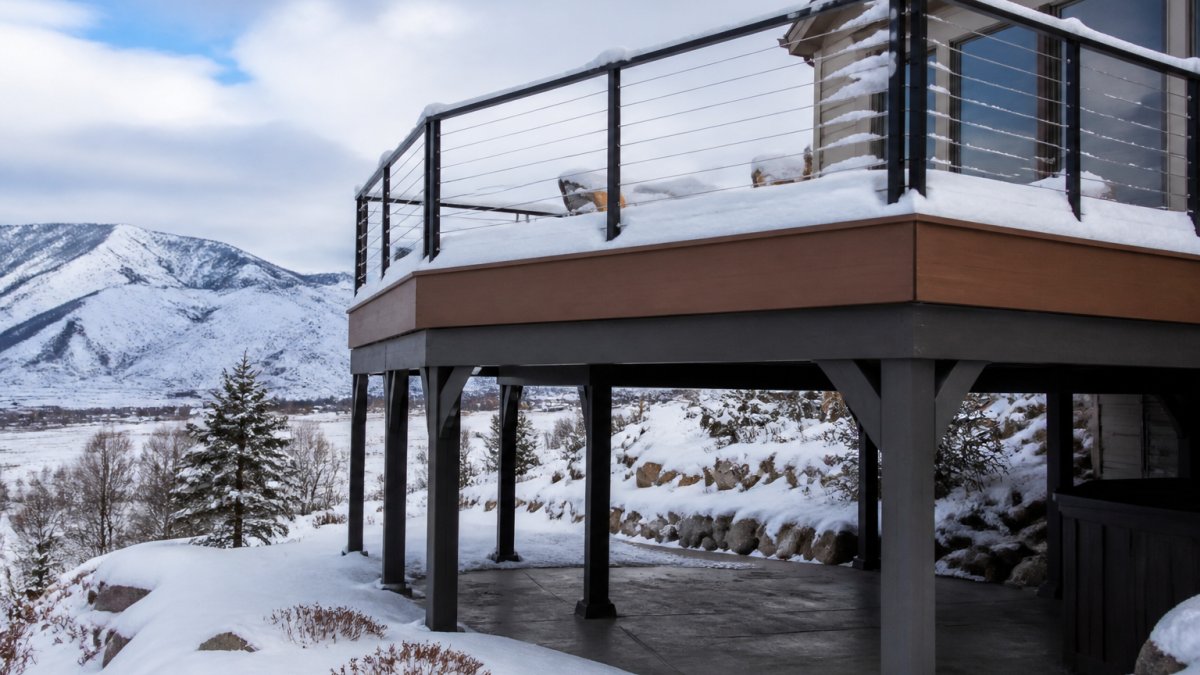
Utah's snow load requirements vary by elevation and location. A deck engineered for typical snow loads will fail under Utah winters.
The engineering shows up in:
- Deeper footings (below frost line)
- Closer post spacing to distribute weight
- Larger diameter posts and beams to handle concentrated load
- Proper drainage to prevent ice damming and water infiltration
A contractor who doesn't mention snow load engineering hasn't done their homework. A contractor who can walk you through their specific calculations for your property knows what they're doing.
What Sets a Premium Deck Contractor Apart
What separates a premium contractor from the rest isn't a single credential, it's a set of verifiable practices you can check before you sign anything. This due-diligence layer is where a careful homeowner can tell a real jv custom decks alternative from a name on a list.
Licensing and Registration
Ask every contractor for their state license number and verify it through the state's online lookup. A legitimate contractor provides it without hesitation; one who deflects, or says licensing "isn't required" for their scope, is a risk. Confirm the license is active, covers your type of work, and isn't expired or under disciplinary action.
Insurance: General Liability and Workers' Compensation
Request a certificate of insurance directly from the insurer, not a photocopy from the contractor. Confirm two things: general liability coverage if your home is damaged during construction, and workers' compensation for anyone on your property, if an uninsured worker is injured, liability can follow you as the property owner. A premium contractor carries both and provides proof on request.
Permitting and Inspection Discipline
A premium contractor pulls the permit in their own name and schedules the required inspections, typically footings, framing, and final. Ask who handles each inspection and what happens if one fails. A contractor who treats permitting as a formality is signaling how they'll treat the rest of the build; one who can walk you through the inspection sequence for your jurisdiction has done it before.
Warranty Structure: Two Warranties, Not One
There are two warranties on every deck, and they are not the same thing:
- The manufacturer's product warranty covers the decking material itself and is typically tied to proper installation. Ask what installation practices void it.
- The contractor's workmanship warranty covers the labor and the structural assembly. Ask how long it lasts, what it covers, and whether it transfers if you sell the home.
Get both in writing. A premium contractor will hand you the documents and explain the exclusions.
Certifications and Ratings Worth Checking
Manufacturer certifications, such as a Trex Pro certification for composite installation, show the contractor has been trained on that product line. Trade and business ratings, such as a BBB rating, are a starting point but no substitute for the checks above. Treat certifications as supporting evidence, not the whole case.
A Due-Diligence Checklist You Can Run in an Afternoon
- Verify the contractor's license number through the state licensing lookup.
- Request a certificate of insurance from the insurer and confirm general liability and workers' comp.
- Ask who pulls the permit and who attends each inspection.
- Get the manufacturer's product warranty and the contractor's workmanship warranty in writing.
- Confirm the warranty's length, exclusions, and transferability.
- Ask for two recent local references and actually call them.
A contractor who passes all six checks is a premium contractor in practice, not just in marketing. That's the standard any jv custom decks alternative should be held to.
Making Your Final Decision
Choosing a deck contractor means choosing someone who will shape your home and outdoor living for decades. Price matters, but it isn't the only thing.
When you've narrowed your options, here's how to decide:
Compare contractors on the criteria that predict success: owner involvement, communication speed, local experience, engineering expertise, and warranty backing. Call their references, ask the hard questions, and trust your instinct about whether they're genuinely interested in your project or just closing a sale.
A jv custom decks alternative isn't about finding someone cheaper. It's about finding someone better aligned with your needs, someone who understands Utah's specific challenges, communicates transparently, and stands behind their work.
The deck contractor you choose will shape your outdoor living for decades. That's worth getting right. At Next Level Exteriors, we quote every project personally within 48 hours, handle all permits and HOA coordination, and engineer every deck specifically for Utah's snow loads and climate.
Frequently Asked Questions
What questions should I ask a deck contractor before hiring them?
Ask about their experience with snow load engineering, how they handle permits and HOA approval, whether they provide a detailed scope of work in writing, their warranty coverage, timeline expectations, and how they manage change orders. Request references from projects completed in your area within the last two years. Verify they're bonded and insured, and ask to see their licensing documentation. Understanding their process for communication and site management helps prevent surprises later.
How do I know a deck contractor can handle Utah's heavy snow loads?
A qualified contractor should explain their engineering approach and reference local building codes specific to your region. They'll discuss post depth, beam sizing, and material selection based on anticipated snow loads. Ask for examples of projects they've completed that survived recent Utah winters without issues. Look for contractors certified by composite decking manufacturers and those familiar with structural requirements for your specific elevation and microclimate.
What should I compare when choosing between deck builders?
Compare their communication style, transparency around costs and timelines, material recommendations for your climate, warranty terms, and whether the owner is directly involved in your project. Evaluate how they handle permits and HOA requirements. Check online reviews for patterns about professionalism and project completion. Consider whether they offer daily site cleanup and how they manage unexpected issues. Get detailed written quotes that break down labor, materials, and permits separately.
Do I need permits for a custom deck project?
Most jurisdictions require permits for deck construction, particularly for structures over 30 inches high or with specific foundation requirements. Permits ensure your deck meets local building codes and snow load standards. A reputable deck contractor handles permit applications and inspections as part of their service. Requirements vary by county and municipality, so confirm with your local building department. Skipping permits can create problems during property sales or insurance claims.
Plan your project with Jake
Share your project type, location, scope and timing. Jake confirms an on-site estimate after your callback.