Durable Patio Covers for Heavy Snow: A 2026 Guide
By Jake Jensen
Table of Contents
- Understanding Snow Load Requirements for Patio Covers
- Best Materials for Winter Patio Covers
- Structural Features That Handle Heavy Snow
- Preventing Snow Accumulation on Pergolas
- Installation: Permanent vs. Temporary Enclosures
- Winter Maintenance and Inspection
- Frequently Asked Questions
Last Updated: September 27, 2026
Understanding Snow Load Requirements for Patio Covers
A snow load rating is the maximum weight of accumulated snow a structure can safely support, measured in pounds per square foot (lb/sf). For patio covers in regions with heavy winter weather, this specification is non-negotiable. It's the difference between a structure that lasts decades and one that fails catastrophically under the weight of a single winter storm.
A single inch of wet, heavy snow adds 10-15 lb/sf of load. Understanding your regional snow load requirements is foundational to choosing durable patio covers for heavy snow that will protect your outdoor space year-round.
Next Level Exteriors designs every patio cover with precise snow load calculations for local conditions, ensuring the structure's load capacity matches the snow your region actually receives.
The International Building Code snow load requirements establish baseline standards that vary by geographic location. Your local building department can provide the exact snow load your area requires. For durable patio covers designed to handle heavy snow, that specification becomes your starting point for material selection and frame design.
Best Materials for Winter Patio Covers
Material choice determines how well a durable patio cover for heavy snow performs over time. Two primary options dominate the market: aluminum and composite. The real durability test comes from exposure to de-icing chemicals and salt spray, factors most homeowners overlook until corrosion appears.
Aluminum vs. Composite vs. Vinyl
Aluminum offers rust-free durability and lightweight strength when properly coated. It won't rot or absorb moisture, making it ideal for regions with significant snow and freeze-thaw cycling. The critical vulnerability: proximity to roads where de-icing salts are applied. Road salt spray can penetrate standard powder coatings within 3-5 years. High-quality marine-grade powder coatings (2-3 mils thick) resist salt spray significantly better than standard 1-mil industrial coatings. Ask contractors whether their aluminum frames use salt-spray-rated coatings (ASTM B117 testing) if your property is within 500 feet of a treated road.
Composite materials like Trex combine wood fibers with plastic polymers and resist rot without staining. Composite is largely immune to salt and de-icing chemicals, a major advantage over aluminum in high-salt environments. The trade-off: composite is heavier, increasing structural demands on support posts. In heavy snow zones, load-bearing capacity becomes critical; undersized posts will fail. Composite delivers decades of maintenance-free performance without the coating degradation concerns that plague aluminum in salty climates.
Durability Under Salt and Chemical Exposure
- Aluminum near salt sources: Requires marine-grade or salt-spray-rated powder coating. Fasteners must be stainless steel, not galvanized. Budget for recoating every 5-7 years if salt exposure is heavy.
- Composite in salt zones: Excellent choice. Resistant to salt spray and de-icing chemicals with no coating degradation risk.
| Material | Snow Load Capacity | Salt/Chemical Resistance | Maintenance | Best For | Durability in Freeze-Thaw |
|---|---|---|---|---|---|
| Aluminum (marine-grade coating) | High (engineered per frame) | Good (with proper coating) | Periodic inspection, fastener checks | Heavy snow, low maintenance, away from salt | Excellent |
| Composite | High (with proper posts) | Excellent | None | Aesthetics + durability + salt exposure | Excellent |
| Vinyl | Moderate | Poor | Minimal | Mild climates only | Poor in extreme cold |
For durable patio covers built to handle heavy snow, composite and aluminum are the practical options. Composite delivers superior longevity and salt resistance; aluminum provides maximum structural efficiency but requires careful attention to coating quality if salt exposure is a factor.
Structural Features That Handle Heavy Snow
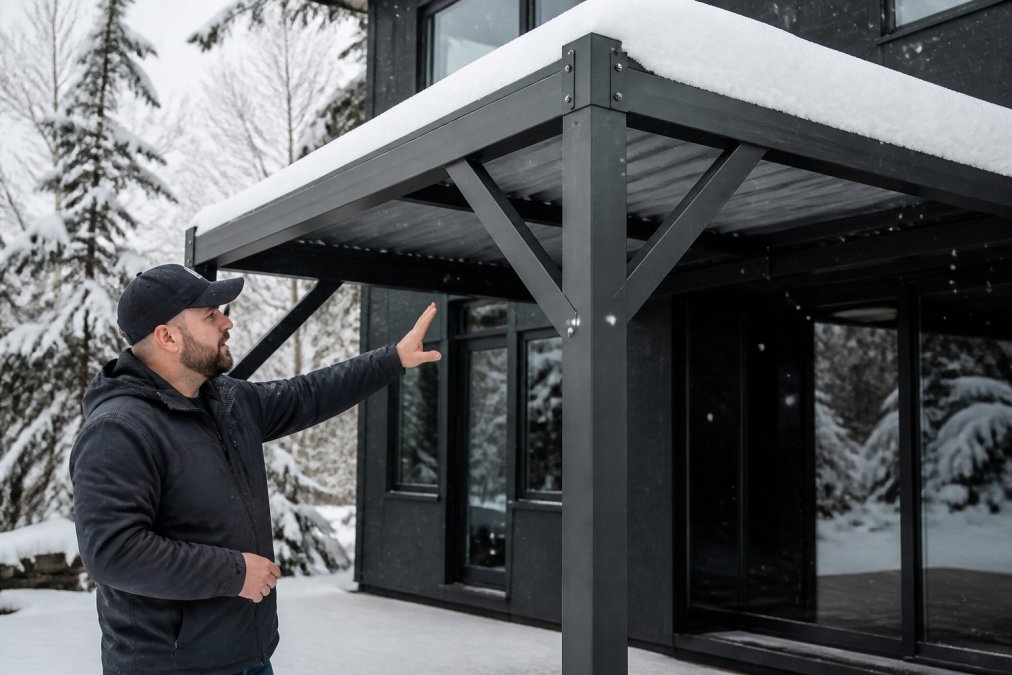
The frame design determines whether your patio cover survives heavy snow or fails. Load-bearing posts must be sized to handle both static load (the cover's own weight) and dynamic load (accumulated snow). Posts should be spaced no more than 8-10 feet apart in heavy snow zones. Bracing and cross-members distribute load across the frame rather than concentrating it at posts.
Preventing Snow Accumulation on Pergolas
Reducing accumulation extends the life of your durable patio cover for heavy snow. Roof pitch is the simplest solution, a steeper pitch (6:12 or greater) sheds snow naturally. Surface texture affects snow retention; smooth surfaces shed faster than rough composite. Snow guards or cleats break up accumulation and prevent dangerous slides. Regular inspection during heavy snow events matters; gently brush or use a roof rake to prevent dangerous overload.
Installation: Permanent vs. Temporary Enclosures
Installation method affects both structural integrity and maintenance burden. Permanent installations involve footings below the frost line, bolted connections, and structural engineering certified by a professional engineer. Permits are required and the structure is inspected by the local building department. Permanent installations handle heavy snow loads because they're engineered and permitted for your specific location.
DIY vs. Professional Installation in Winter Conditions
Winter installation introduces hazards and quality failures that professionals manage:
Professional installation safety protocols in freezing weather:
- Concrete curing in cold: When temperatures drop below 50°F, curing slows dramatically. Professional crews use heated enclosures, accelerated concrete mixes, or schedule installation for warmer months. Improper curing results in weak footings that shift and heave under frost pressure.
- Fastener tightening and torque: Metal contracts in cold. Professionals use thread-locking compounds and verify torque specifications with calibrated tools. DIY installers often skip this step, leading to loose connections that fail under load.
- Material brittleness: Aluminum, composite, and vinyl become more brittle in extreme cold. Drilling or forcing connections in sub-freezing temperatures increases cracking risk. Professional crews work within material temperature ranges or defer installation.
- Footing depth verification: Frost lines vary by region (typically 24-48 inches in snow zones). Professionals have equipment to reach proper depth safely. DIY installers often place footings above the frost line, a critical failure point.
When Professional Installation is Non-Negotiable
For regions with significant snow, permanent installation by professionals is the only practical choice. The additional cost upfront prevents far more expensive failures and liability issues later. Specifically:
- Snow load engineering: A professional engineer calculates the exact snow load your structure must support based on your zip code and local building code. This isn't guesswork; it's a structural calculation that determines post size, bracing, and footing depth. DIY installers typically use generic sizing, which often undershoots the actual requirement.
- Building permits and inspections: Permits require a licensed contractor or engineer to sign off on the design. Inspectors verify that footings are at proper depth, that connections are bolted correctly, and that the structure meets code. This oversight prevents catastrophic failures. Unpermitted structures have no such safeguard.
- Liability and insurance: If an unpermitted structure fails and causes injury or property damage, homeowner liability insurance may not cover it. Permitted structures with professional installation are covered under standard homeowner policies and contractor liability.
Winter Maintenance and Inspection
Durable patio covers for heavy snow require seasonal attention when well-engineered. Pre-winter inspection identifies issues before heavy snow arrives, check for loose fasteners, cracks, rust spots, or water damage. During-winter monitoring means checking the structure after major snow events for sagging or stress. Post-winter assessment in spring checks for heaving, water pooling, or ice damage. Drainage maintenance prevents water pooling and ice hazards.
Frequently Asked Questions
How do I determine the required snow load rating for my patio cover?
Snow load ratings are measured in pounds per square foot (lb/sf) and depend on your geographic location and typical winter precipitation. The International Building Code (IBC) and local building departments publish snow load maps for your area. For heavy snow regions, ratings typically range from 30 to 150+ lb/sf. Contact your local building department or work with a custom installer who understands regional requirements, they can calculate the exact load your structure needs to handle based on your location and roof pitch.
What's the difference between static and dynamic snow loads on a patio cover?
Static load refers to the weight of snow sitting motionless on the roof. Dynamic load accounts for wind shear, ice accumulation, and the sudden shifting of snow as it slides or melts. Durable patio covers must handle both. A structure rated for static load alone may fail when wind gusts push accumulated snow or when ice damming creates uneven weight distribution. Professional engineering for heavy snow areas always factors in dynamic load to ensure structural integrity year-round.
Are composite materials or aluminum better for heavy snow climates?
Aluminum frames with insulated roof panels are the standard for heavy snow areas because aluminum has high tensile strength and won't warp under load. Composite materials (like Trex) work well for deck surfaces but aren't ideal for load-bearing roof structures. For patio covers specifically, powder-coated aluminum resists corrosion and rust-free construction is essential in freeze-thaw cycles. Insulated roof panels provide thermal efficiency and help prevent ice damming. The best winter patio covers combine aluminum structural framing with weather-resistant, insulated panels.
What maintenance does a patio cover need during winter?
Inspect your patio cover before heavy snow arrives: check all fasteners, seals, and anchoring systems for tightness. After storms, clear accumulated snow and ice to prevent overloading. Use a soft broom or plastic shovel, never metal tools that can damage panels. Keep gutters and drainage paths clear so meltwater doesn't pool and freeze. Powder-coated finishes are maintenance-free, but check for any cracks in the seal where moisture could enter. A quick visual inspection every few weeks during winter prevents small issues from becoming structural problems.
Plan your project with Jake
Share your project type, location, scope and timing. Jake confirms an on-site estimate after your callback.