
Composite vs Cedar for Mountain Homes: 2026 Guide
By Jake Jensen
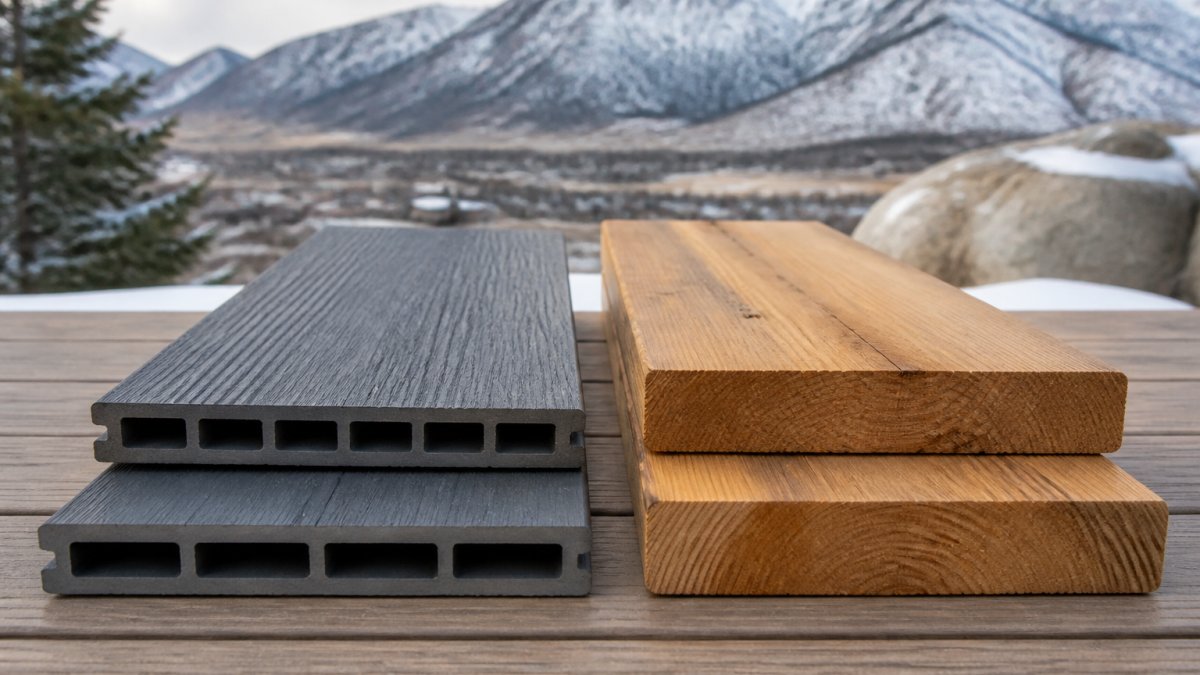
Table of Contents
- Composite Decking vs Cedar for Mountain Homes: Material Overview
- Initial Material and Installation Costs
- Composite Decking Pros and Cons for Mountain Climates
- Cedar Decking Maintenance and Long-Term Care
- Composite Decking in Cold Climates: Performance and Durability
- Composite Decking Snow Load Capacity and Mountain Engineering
- Lifespan, Warranty, and Long-Term Value
- Which Material Is Right for Your Mountain Home
- Frequently Asked Questions
Last Updated: October 5, 2026
Composite Decking vs Cedar for Mountain Homes: Material Overview
When you're choosing between composite decking vs cedar for a mountain home, you're making a decision that affects durability, maintenance, and long-term value. Mountain climates present unique challenges, freeze-thaw cycles, heavy snow loads, intense UV exposure, and dramatic temperature swings, that test any decking material's limits.
Composite decking and cedar each handle these conditions differently. Cedar offers natural beauty and traditional appeal, but requires consistent maintenance to survive mountain winters. Composite decking, engineered to resist moisture and temperature extremes, demands far less upkeep and performs predictably in harsh conditions.
At Next Level Exteriors, we've built hundreds of decks across the Wasatch Front, and we've learned that the "best" material depends on your priorities: if you value minimal maintenance and engineered reliability, composite wins. If you prefer natural wood aesthetics and are willing to invest in regular care, cedar has appeal, but mountain climates make that maintenance more demanding than in lower elevations.
This guide breaks down what each material actually delivers in mountain conditions, the real costs involved, and how to choose based on your home's specific climate and your lifestyle.
Initial Material and Installation Costs
The upfront price difference between composite decking and cedar can be substantial, but it tells only part of the story.
Cedar decking typically costs less per board initially. The material itself is more affordable, and installation labor is straightforward since cedar works with standard framing and fastening methods. However, "initial cost" is misleading, it doesn't account for the finishing work cedar demands before you can even use the deck.
Composite decking carries a higher material price tag. The boards themselves cost more, and installation requires precision to account for thermal expansion and contraction, a critical detail in mountain climates where temperature swings can exceed 50 degrees in a single day.
Beyond material and labor, cedar requires immediate finishing: staining, sealing, or both. These treatments aren't optional in mountain environments, they're necessary to protect the wood from UV damage and moisture penetration. That first-year finishing cost is often overlooked in budget comparisons but represents a significant expense.
Composite decking arrives ready to install. No stain, no seal, no finish coat. You build it and use it.
For a typical mountain-home deck project, the initial cost difference might range from modest (if cedar is minimally finished) to substantial (if cedar receives full protective treatment). Next Level Exteriors provides transparent quotes that account for all these components, so you understand exactly what you're paying for upfront.
Composite Decking Pros and Cons for Mountain Climates
Composite decking shines in mountain conditions because it was engineered for exactly these challenges: moisture, temperature extremes, and UV exposure.
Advantages in mountain settings:
Composite resists moisture absorption entirely. Mountain snowmelt, rain, and humidity cannot penetrate the material, eliminating rot risk, the primary failure mode for cedar in cold climates.
Freeze-thaw cycles don't crack composite the way they crack cedar. When water enters wood, it expands as it freezes and contracts as it thaws, eventually splitting the fibers.
Color stability matters on a visible structure. Composite fades slowly and predictably over years. Cedar grays rapidly, within one season in mountain sun, unless continuously maintained with sealant reapplication.
Composite requires no staining, sealing, or annual touch-ups. You clean it occasionally and that's the extent of maintenance. For mountain homeowners who don't want to manage a deck project every few years, this is transformative.
Limitations:
Composite can feel less "natural" aesthetically. If you value authentic wood grain and warmth, composite's engineered appearance may not match your vision, though modern composites have improved significantly in texture and color variety.
Thermal expansion is real and must be managed correctly during installation. In mountain temperature swings, composite boards move more than cedar. Poor installation that ignores this movement causes gaps, buckling, or fastener failure.
Cost remains higher upfront. The long-term value is strong, but the initial investment is larger.
Cedar Decking Maintenance and Long-Term Care
Cedar is beautiful, but mountain climates are unforgiving to wood. Cedar requires active management to survive.
Annual sealing or staining is the baseline. In mountain environments with intense sun and heavy moisture, many cedar decks need attention every 12-18 months, not every 2-3 years. Neglect for even one season allows UV damage and moisture penetration to accelerate.
Rot prevention is constant work. Cedar resists rot better than pressure-treated lumber, but it's not rot-proof. Moisture finds its way into end grain, under fasteners, and into joints. Once rot establishes, repair means replacing boards, an expensive, ongoing cycle.
Snow and ice management affects cedar differently than composite. Cedar's porous surface can trap moisture under snow, accelerating decay. Composite's sealed surface sheds moisture and resists the same damage.
Splinter management becomes necessary as cedar ages. Weathering breaks down surface fibers, creating splinters that worsen over time. Sanding and refinishing address this temporarily but don't solve it permanently.
Fastener corrosion is another consideration. Cedar requires stainless steel fasteners to prevent rust staining and degradation. Copper or galvanized fasteners will fail and discolor the wood. This detail adds cost and requires attention during installation and any future repairs.
The honest assessment: cedar in a mountain climate demands a homeowner willing to invest time and money in regular maintenance. If you're prepared for that commitment, cedar offers natural beauty.
Composite Decking in Cold Climates: Performance and Durability
Composite was developed specifically to solve the problems that plague wood in harsh climates. Cold weather actually reveals composite's advantages.
Moisture doesn't penetrate composite, so freeze-thaw cycles that destroy wood leave composite unaffected. The material expands and contracts with temperature, but it doesn't absorb water that would amplify that movement and cause cracking.
UV resistance in composite is engineered in. Mountain sun is intense at elevation, and composite's protective cap layer shields the core from fading and degradation. Colors shift subtly over 10-15 years, but the material's structural integrity remains unchanged.
Thermal movement requires correct installation, but it's predictable and manageable. Next Level Exteriors designs every deck with proper gapping and fastening to accommodate the movement that occurs in mountain temperature swings. When installed correctly, this movement is never a problem.
Composite's surface stays cleaner in snowy conditions. Snow doesn't bond to composite the way it can to weathered cedar, making seasonal cleanup easier. The material's moisture resistance means no hidden rot developing under snow accumulation.
Performance data from composite manufacturers shows service life of 25-30+ years in cold climates, with minimal degradation. Cedar's service life in the same conditions is shorter and highly dependent on maintenance consistency.
Composite Decking Snow Load Capacity and Mountain Engineering
This is where composite decking and cedar diverges most sharply in mountain applications. Snow load capacity isn't just about material strength, it's about engineered systems.
Composite decking's structural properties remain stable across temperature ranges. Cedar's strength can degrade as moisture content fluctuates, especially if the wood experiences repeated wet-freeze cycles. Composite's properties don't shift with weather.
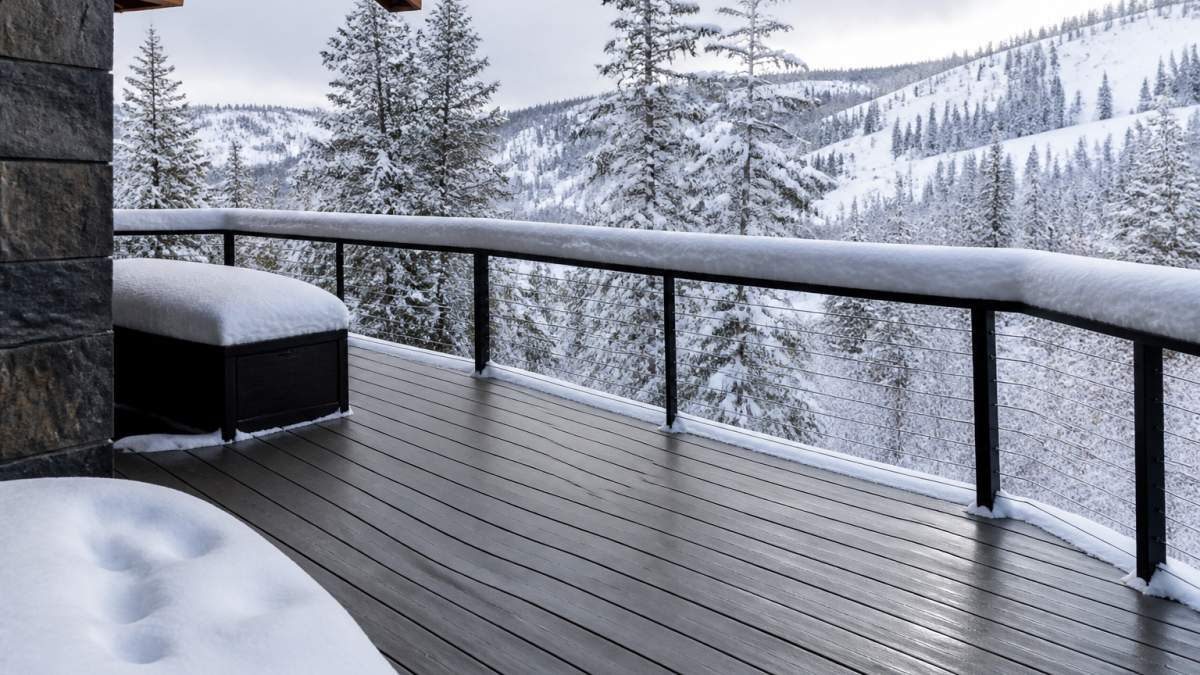
Mountain building codes require decks engineered for regional snow loads. In the Wasatch Front, that typically means decks rated for 40-60 pounds per square foot of snow weight, depending on elevation and exposure.
Composite decking's consistent strength across temperature ranges makes load calculations straightforward and reliable. Engineers can specify composite with confidence that performance will match calculations year after year.
Cedar's load capacity depends on wood grade, moisture content, and condition. A cedar deck that's properly maintained might handle snow loads adequately. One that's weathered, partially rotted, or experiencing freeze-thaw damage will fail unpredictably.
At Next Level Exteriors, every deck is custom-engineered for your specific location's snow load requirements. We design the substructure, beam size, post spacing, footing depth, to handle the loads your site will experience.
Lifespan, Warranty, and Long-Term Value
The true cost comparison between composite decking and cedar emerges over time, not upfront.
Composite decking typically carries 25-30 year warranties against structural failure and material defects. Some manufacturers extend warranties to 30+ years. These warranties are realistic, composite decks commonly perform for 30+ years with minimal intervention.
Cedar decks typically last 10-15 years before significant rot, splinter, or structural issues emerge. This isn't a defect in cedar itself; it's the reality of wood in mountain climates. A well-maintained cedar deck might reach 15-20 years. A neglected one fails faster.
Warranty coverage reflects this difference. Cedar typically carries shorter warranties because wood's lifespan in harsh climates is inherently limited.
Long-term value calculation changes the picture dramatically. A composite deck that lasts 30 years with minimal maintenance costs less over its lifetime than a cedar deck requiring staining every 18 months, board replacement every 7-10 years, and eventual complete replacement at year 15-20.
Consider the math: if cedar costs less initially but requires annual maintenance, plus repairs by year 10, plus complete replacement by year 20, the total cost over 30 years exceeds a composite deck's cost significantly.
Composite's value proposition is strongest for homeowners planning to stay in their mountain home long-term. If you're selling within 5-7 years, upfront cost matters more. If you're building a permanent mountain residence, composite's lifecycle cost advantage becomes decisive.
Which Material Is Right for Your Mountain Home
Your choice depends on three factors: your maintenance tolerance, your timeline, and your climate's specific demands.
Choose composite decking if:
You want a deck that performs reliably without constant attention. Mountain climates are unforgiving; composite eliminates the guesswork and the annual maintenance cycle.
You're planning to keep your home long-term.
Your elevation is high or your site receives intense sun exposure. Composite's UV and freeze-thaw resistance becomes increasingly valuable as conditions become harsher.
You value predictability. Composite performs consistently; cedar's performance depends on maintenance consistency, which varies by season and homeowner commitment.
Choose cedar if:
You prioritize natural wood aesthetics and are willing to invest in regular maintenance.
Your mountain climate is milder (lower elevation, less snow, less sun exposure). Cedar performs better in moderate conditions than extreme ones.
You're comfortable with a 10-15 year deck lifespan and plan to replace or refinish significantly before year 20.
You have the time and budget for annual sealing, occasional repairs, and eventual board replacement.
For most mountain homeowners, composite decking and cedar tips toward composite.
That said, we build both materials.
Your deck should enhance your mountain home, not become a source of stress. Let's build something that performs.
Mountain decks face challenges most homeowners don't anticipate until winter arrives. Heavy snow, freeze-thaw cycles, and intense UV exposure test materials ruthlessly.
Frequently Asked Questions
Which is better for mountain homes, composite or cedar decking?
Composite decking outperforms cedar for mountain climates because it resists freeze-thaw cycles, moisture, and rot without seasonal sealing. Cedar requires regular maintenance in harsh winters and degrades faster under heavy snow loads. For mountain homes, composite decking's durability and engineered snow-load capacity make it the more reliable choice, though cedar offers natural aesthetics if you commit to annual upkeep.
How does composite decking perform in snow and freezing temperatures?
Quality composite decking is engineered to handle freeze-thaw cycles without cracking or warping. The material doesn't absorb moisture, so ice buildup doesn't damage the boards. Composite decking in cold climates maintains structural integrity under heavy snow loads when properly installed with engineered substructure support. Cedar, by contrast, absorbs water during winter thaws, leading to rot and splitting when temperatures drop again.
What are the main drawbacks of composite decking?
Composite decking can fade under prolonged UV exposure and may develop surface mold or mildew in shaded, damp areas if not cleaned regularly. Some composite products show less slip resistance when wet or icy compared to textured cedar. Initial material costs are higher than cedar, though the reduced maintenance and longer lifespan offset this over time. Proper drainage and ventilation during installation prevent most moisture-related issues.
Does cedar decking need regular sealing in mountain climates?
Yes, cedar decking requires sealing every 1-2 years in mountain climates to prevent moisture absorption, rot, and insect damage. Freeze-thaw cycles accelerate wood degradation, making regular staining and sealing essential for durability. Without this maintenance commitment, cedar deteriorates quickly in harsh winters and heavy snow exposure. Composite decking eliminates this recurring maintenance requirement entirely.
How should a deck be designed for heavy snow loads in mountains?
Mountain decks require engineered substructure with deeper footings below the frost line, increased post spacing, and reinforced framing to handle snow weight. Proper slope and drainage prevent ice damming. Material choice matters: composite decking's consistent strength supports engineered designs better than cedar, which can warp under load. Professional engineering for your specific elevation and local snow conditions is essential to prevent structural failure.
Plan your project with Jake
Share your project type, location, scope and timing. Jake confirms an on-site estimate after your callback.