
7 Ways to Prevent Composite Deck Heat Buildup
By Jake Jensen
Table of Contents
- Why Composite Decks Absorb Heat and What You Can Do About It
- 1. Choose Lighter-Colored Composite Decking That Stays Cool
- 2. Select Heat-Resistant Composite Decking Materials
- 3. Install Shade Structures: Pergolas, Sails, and Umbrellas
- 4. How to Keep Composite Decking Cool Through Regular Cleaning
- 5. Improve Airflow and Drainage Underneath Your Deck
- 6. Use Approved Surface Coverings and Outdoor Rugs
- 7. Consider Misting Systems and Cooling Options
- Summary: A Practical Seven-Step Plan
- Getting Started with Next Level Exteriors
- Frequently Asked Questions
Last Updated: October 16, 2026
Why Composite Decks Absorb Heat and What You Can Do About It
Composite decking absorbs and retains solar heat more than many homeowners expect. Engineered from wood fibers and plastic binders, the boards trap heat rather than reflecting it.
At Next Level Exteriors, we've helped dozens of homeowners across the Wasatch Front address this through material choices, shade solutions, and maintenance. The good news is that composite deck heat buildup is preventable without sacrificing durability or low maintenance.
1. Choose Lighter-Colored Composite Decking That Stays Cool
Color directly impacts how much heat your composite decking absorbs. Lighter shades, whites, tans, grays, and soft browns, reflect more solar energy, while darker colors have lower albedo (reflectivity) and convert more of the sun's energy to heat.
The tradeoff is aesthetic. If your design calls for darker boards, lean on shade structures and surface coverings; if you have flexibility, going lighter is the simplest way to prevent composite deck heat buildup from the start.
2. Select Heat-Resistant Composite Decking Materials
Beyond color, some manufacturers engineer boards to reduce heat absorption using reflective pigments, modified surface textures, or different binder formulations that lower surface temperatures compared with standard composite decking. Trex SunComfortable, for example, reflects solar energy to reduce heat absorption.
When you build or replace your deck, ask your contractor about heat-resistant options in your preferred color. The comfort improvement, especially in a hot climate or south-facing location, can justify the modest upgrade. Next Level Exteriors is Trex Pro Certified and can guide material selection based on your sun exposure.
3. Install Shade Structures: Pergolas, Sails, and Umbrellas
Overhead shade is the most effective way to keep direct sunlight off your deck surface. Without it, even light-colored boards warm up significantly; with it, you can cut surface temperature by 30-50 degrees.
Pergolas and Roof Additions
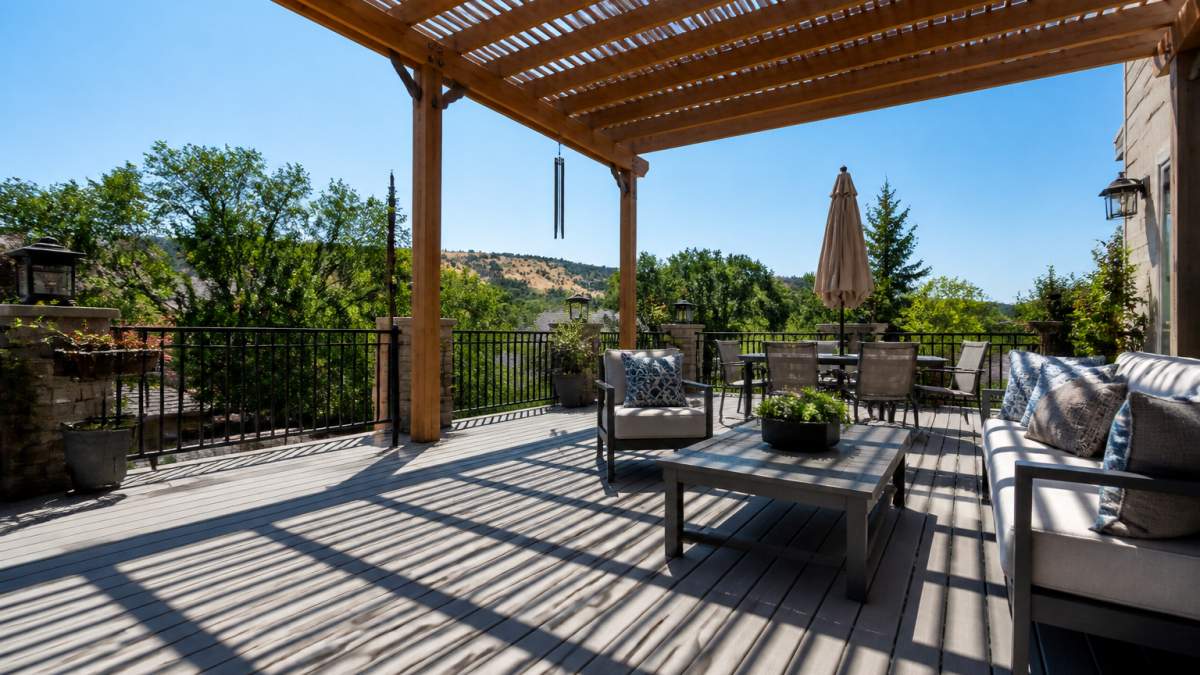
A pergola is a semi-permanent structure whose slatted roof provides partial shade while allowing dappled light and airflow.
(/services/patio-covers) (a patio cover) blocks all direct sunlight and provides the most dramatic temperature reduction, but it's a significant construction project.Shade Sails and Retractable Awnings
Shade sails are fabric structures stretched between posts or attachment points. They cost less than a pergola or roof addition, can be positioned to shade specific areas, and can be removed or adjusted seasonally. A retractable awning offers similar flexibility, extending when you need shade and retracting when you don't.
Umbrellas and Portable Options
For smaller areas or temporary shade, large outdoor umbrellas are affordable, easy to move, and require no installation, though they shade only a limited area.
4. How to Keep Composite Decking Cool Through Regular Cleaning
Dirt, leaves, pollen, and organic matter accumulate over time, darkening boards, reducing reflectivity, and increasing heat absorption. A clean deck stays cooler than a dirty one, sometimes by 10-20 degrees.
Regular cleaning is one of the simplest, most cost-effective ways to manage composite deck heat buildup. Sweep weekly during warm months, and every month or two wash with mild soap and water using a soft brush or low-pressure washer to remove algae, mold, and dirt that trap heat.
5. Improve Airflow and Drainage Underneath Your Deck
Most heat-reduction advice stops at the top of the board, but the space underneath is part of the thermal system. A composite board absorbs solar energy on top and releases some downward; if the air beneath is stagnant, the cavity warms and the board sheds heat slowly, staying hotter well into the evening. Move air through the cavity and the board dumps heat downward much faster.
What good under-deck airflow looks like
Airflow is a pass-through, not a single opening. You want a low intake on the prevailing-wind side and a high exhaust opposite, so cooler air enters low, warms, rises, and exits. A single vent does little because there's no pressure difference to drive movement.
Design factors that matter:
- Clearance. More open space between the ground and the underside of the framing gives hot air room to stratify and escape. Tight clearances trap it.
- Skirting and solid barriers. Solid skirting turns the under-deck area into a closed box. If you want skirting for looks, use a design with built-in vent panels rather than a solid panel run.
- Cross-ventilation. Openings on at least two opposing sides outperform a single large opening every time.
Drainage is the other half of the equation
Standing water keeps the cavity humid, changing how heat is held and transferred and creating conditions for mold and algae on the underside of boards and framing.
If water consistently collects after rain, solve the drainage before it becomes a rot or mildew problem. Regrading, a shallow swale, or a French drain are the usual fixes, far cheaper during a build than as a retrofit.
What to do if your deck is already built
You do not need to rebuild to improve this. Practical retrofits include:
- Adding vent panels to existing skirting, placed low on one side and high on the opposite side.
- Removing a section of solid skirting to open a cross-flow path.
- Clearing stored items and vegetation away from existing openings.
- Regrading soil or extending a downspout to move water away from the footprint.
This lever is decided almost entirely at design and construction time. If you're planning a new deck, raise the airflow and drainage question before the framing goes up, because it's trivial to build in and awkward to add later. If your deck already exists, the retrofits above are low-cost and can meaningfully change how quickly the surface cools after sunset.
6. Use Approved Surface Coverings and Outdoor Rugs
A surface covering blocks direct sunlight from reaching the board, so the board never absorbs that solar energy. The covered section stays noticeably cooler than the exposed section next to it. The catch is that composite boards need to dry out and breathe, so the covering you choose matters as much as using one.
How to pick a covering that won't damage the boards
Manufacturers generally draw the line at coverings that trap moisture against the surface for long stretches. One that stays wet underneath or sits for months without being lifted is most likely to leave discoloration or encourage mildew. Check your board's care documentation, because approval varies by brand and product line.
Use these criteria to sort options:
- Breathability. Open-weave and mesh-backed products let air move and moisture escape. Solid rubber-backed mats and non-porous pads hold water against the board.
- Lift-ability. Anything you can roll up, flip, or move every week or two is safer than something screwed down or weighted in place all season.
- Color and backing. A light-colored face reflects more sun; a dark or rubberized backing can transfer heat and, in some cases, mark the board.
- Drainage underneath. Water should be able to run off the deck surface, not pool between the covering and the board.
Covering types compared
| Covering | Shade provided | Moisture risk | Effort | Best use |
|---|---|---|---|---|
| Outdoor area rug (breathable backing) | High over covered zone | Moderate if left down | Low | Seating and dining zones |
| Interlocking deck tiles | High over covered zone | Low, raised on feet | Medium | Walkways and high-traffic paths |
| Roll-up bamboo or reed mat | Medium | Low, dries fast | Low | Temporary shade over a sitting area |
| Shade cloth laid over a section | Medium | Low | Low | Quick seasonal relief |
| Solid rubber-backed mat | High | High | Low | Avoid on composite |
The maintenance routine that keeps it safe
A covering is only low-risk if you treat it as seasonal. Lift or roll it every week or two during warm months, let the board dry fully, sweep away grit, then put it back. Grit trapped under a mat acts like sandpaper against the finish over time. A faint outline where the covering sat is usually surface residue rather than permanent staining, and a mild soap-and-water wash with a soft brush typically lifts it.
The advantage of coverings is flexibility: shade a seating zone without building anything, move it as needs change, and remove it in cooler months. The limitation is that it only cools the area it covers, so it works best as a targeted fix layered on top of shade and lighter board color.
7. Consider Misting Systems and Cooling Options
For active cooling, misting systems spray a fine mist over the deck on hot days. The evaporating water cools the deck, sometimes by 10-15 degrees.
Deck fans improve air circulation and create a cooling effect similar to a ceiling fan indoors. Like misting systems, they work best with shade and are not a standalone solution to composite deck heat buildup.
Summary: A Practical Seven-Step Plan
| Strategy | Effort Level | Effectiveness | Best For |
|---|---|---|---|
| Choose lighter colors | Low (design phase) | High | New deck builds |
| Select heat-resistant materials | Low (material upgrade) | High | New installations |
| Install pergola or shade sail | Medium (installation) | Very high | Sunny locations |
| Clean regularly | Low (ongoing) | Medium | All decks |
| Improve airflow | Medium (construction) | Medium | New builds or renovations |
| Use approved rugs | Low (seasonal) | Medium | Seating areas only |
| Add misting or fans | Medium (installation) | Low-medium | Extreme heat situations |
The most effective approach combines strategies: start with a lighter board color if you're building new, add a shade structure for maximum impact, and keep a regular cleaning routine to maintain reflectivity.
Getting Started with Next Level Exteriors
If you're planning a new composite deck or upgrading an existing one, your design and material decisions have the biggest impact on heat performance.
We handle permits, HOA paperwork, and provide transparent quotes within 48 hours, no commissioned salesmen, no surprise costs.
Trex's guide to heat-resistant composite decking explains the engineering behind their heat-mitigating products.
Ready to build a deck that stays comfortable in the summer sun? Reach out to Next Level Exteriors for a free consultation and quote.
Frequently Asked Questions
Does the color of composite decking affect how hot it gets?
Yes. Lighter-colored composite decking reflects more solar energy and stays cooler than dark boards. Dark composite decking absorbs significantly more heat from direct sunlight, making the surface uncomfortable for bare feet on hot days. When choosing composite decking colors and heat retention, lighter shades are the better choice for sunny locations. Trex and TimberTech both offer lighter color options designed to reduce heat absorption compared to darker alternatives.
Is there a composite decking that does not get hot?
No composite decking stays completely cool in direct sunlight, but some materials absorb and retain less heat than others. Trex SunComfortable is engineered to reflect solar energy and reduce heat absorption compared with standard composite decking. The best approach combines a heat-resistant material with lighter colors, shade structures, and regular maintenance. Testing boards in direct sunlight for at least two hours before purchase helps you assess how hot a specific product gets in your local conditions.
How can I keep my composite deck cooler on sunny days?
Use a combination of strategies: install shade structures like pergolas or shade sails to block direct sunlight, choose lighter-colored boards, keep the deck clean to remove dirt buildup that increases heat absorption, and ensure good airflow underneath. On extremely hot days, outdoor rugs approved for composite decking or a misting system can provide additional cooling. Regular seasonal maintenance, including sweeping and cleaning with soap and water, helps maintain the deck's ability to stay as cool as possible.
What should I look for in heat-resistant composite decking?
Look for composite decking that stays cool by checking the manufacturer's heat-retention data and testing samples in direct sunlight. Lighter colors naturally stay cooler than dark boards. Materials with higher PVC content or reflective surfaces tend to perform better in hot conditions. Ask your contractor about manufacturer recommendations for your climate. Next Level Exteriors, a Trex Pro Certified installer, can help you select materials specifically engineered to handle intense sun exposure while maintaining comfort and durability.
Plan your project with Jake
Share your project type, location, scope and timing. Jake confirms an on-site estimate after your callback.